5 min. read · By Luc Mangin · 9 August 2026
Editorial by Luc Mangin
Philatelists have always had to fight fakes. Regumming, forged postmarks, chemically cleaned stamps—the traditional market has never been immune to fraud. But a new generation of postage stamps is rewriting the rules of authenticity, relying on a technology that makes counterfeiting not only difficult, but mathematically impossible.
The Physical Stamp Is Only Half the Story
Each crypto stamp is a dual object. On one side, it is a classic postage stamp printed on paper, perforated, gummed, and valid for postage.
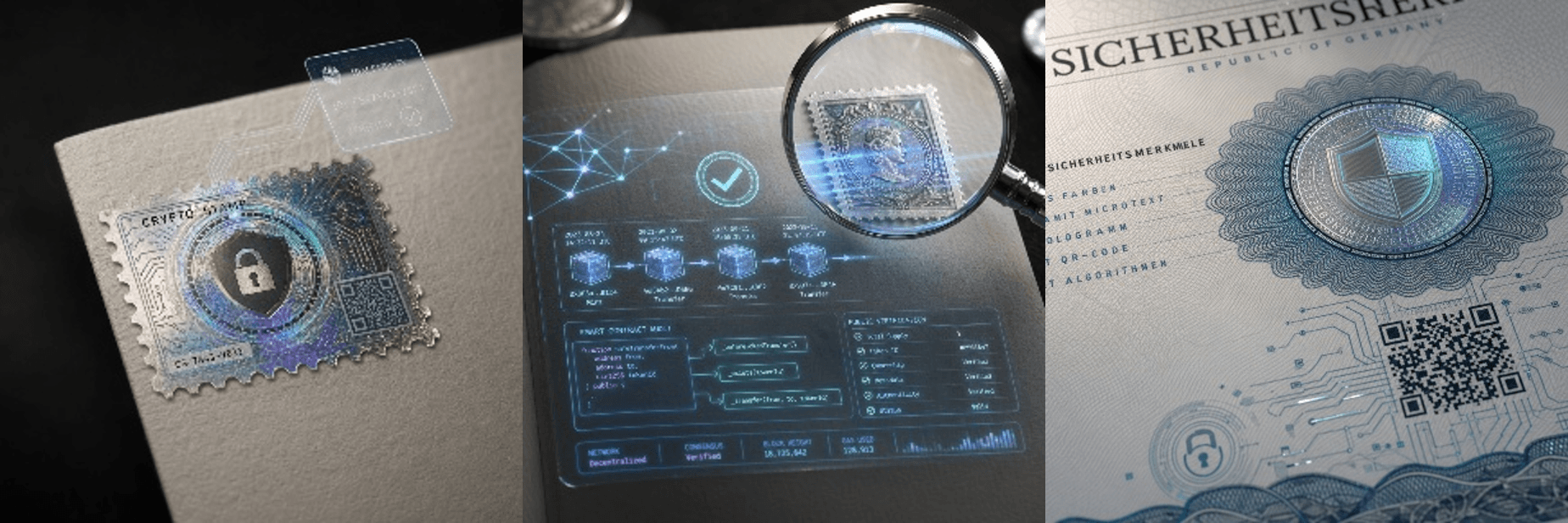
On the other, there is a QR code or a hidden NFC chip, protected by a tamper‑evident layer. Scratch or peel away this protection and you reveal a unique identifier that unlocks a digital twin stored on a blockchain: an NFT (Non‑Fungible Token), issued under various standards including ERC‑721, which ensures that each token is truly unique and indivisible.
This physical–digital pairing forms the foundation of the entire security architecture. The stamp you hold in your hand and the token on the blockchain are permanently linked—not by a paper certificate that can be lost or forged, but by a cryptographic code recorded in a public, immutable ledger.
Security Layers: From Ink to Algorithms
Anti‑counterfeiting protection for crypto stamps operates simultaneously at several levels.
At the physical level, these stamps incorporate elements familiar from banknote printing: UV‑reactive inks, forensic markers invisible to the naked eye, and tamper‑evident packaging. Some issues include NFC chips secured with AES‑SUN NDEF encryption—the same class of technology used in modern passports and contactless payment cards. Any attempt to clone or replicate the chip without the cryptographic key produces an invalid signature that can be detected immediately.
At the digital level, the blockchain provides what no paper document has ever been able to guarantee: a public, permanent, auditable chain of custody. Each NFT has a unique contract address on Ethereum or Polygon. Every transfer of ownership—from the postal operator to the first buyer, from collector to collector—is recorded in order, time‑stamped, and visible to everyone.

Traceability: A Complete Ownership History
For collectors, traceability may be the most transformative feature. With a traditional rare stamp, provenance rests on handwritten sales records, dealer certificates, and the good faith of prior owners. With a crypto‑stamp NFT, the entire ownership history is embedded in the token itself—verifiable in seconds, without requiring an expert opinion.
Platforms dedicated to cataloging these issues allow collectors to cross‑reference physical stamps with their blockchain records, to verify QR codes under controlled conditions, and to spot inconsistencies that reveal a fake such as a QR code that has already been scanned and linked to a different digital wallet.
How Authentication Works
Each crypto stamp links a physical object to a digital twin. The postal operator creates a unique NFT—a non‑fungible token—and associates it with a specific stamp via a QR code protected by a scratch‑off layer. When a collector scratches and scans, the NFT is claimed and permanently recorded on the blockchain. From that moment on, ownership is transparent, time‑stamped, and publicly verifiable by anyone in the world—without an expert certificate.
Traceability: Auditability & Smart‑Contract Guarantees
Unlike a traditional album, the blockchain makes provenance auditable: transfers are time‑stamped, ordered, and publicly verifiable, which helps detect gaps, duplicates, or suspicious activity around a given stamp. It also enables features that paper records cannot provide, such as programmatic rarity variants (the digital equivalent of printing varieties), whose scarcity is enforced by the smart contract itself.
The blockchain does not lie. But everything that happens “before” you get there remains vulnerable.
1. falsified QR code on the physical stamp. The most documented fraud in the crypto‑stamp world involves altering or replacing the QR code on the physical stamp. The paper stamp is authentic—printed by the official postal operator—but the QR code has been modified to point to an NFT that has already been claimed, or to a fake digital twin. A stamp sold with its protective layer already scratched off is a critical red flag: the NFT may already be gone.
2. Fake collections on OpenSea. Fraudsters create fake OpenSea collections by copying the visuals of official issues, then sell worthless NFTs to unsuspecting collectors. Identified fraudulent URLs imitated stamps from Swiss Post, the Polish Post, and the United Arab Emirates. Always verify the smart contract address published on the issuing postal operator’s official website before any purchase, or on https://crypto-stamps.org.
3. A physical stamp sold without its NFT. A stamp is listed for sale with its scratch‑off layer already removed. The seller claimed the NFT before the sale. The buyer receives authentic paper with no blockchain value attached.
The Collector’s Checklist

Conclusion
Crypto stamps represent a real advance in philatelic security, but not an unconditional guarantee. The blockchain is the most reliable part of the system. The physical QR code, the scratch‑off layer, and the marketplace listing remain human territory—and human territory can be exploited. Verify before you buy. The ledger is incorruptible. The sticker placed on top of it may not be.