Blockchain explained to Philatelists
4 min. read · By Luc Mangin · 8 June 2026
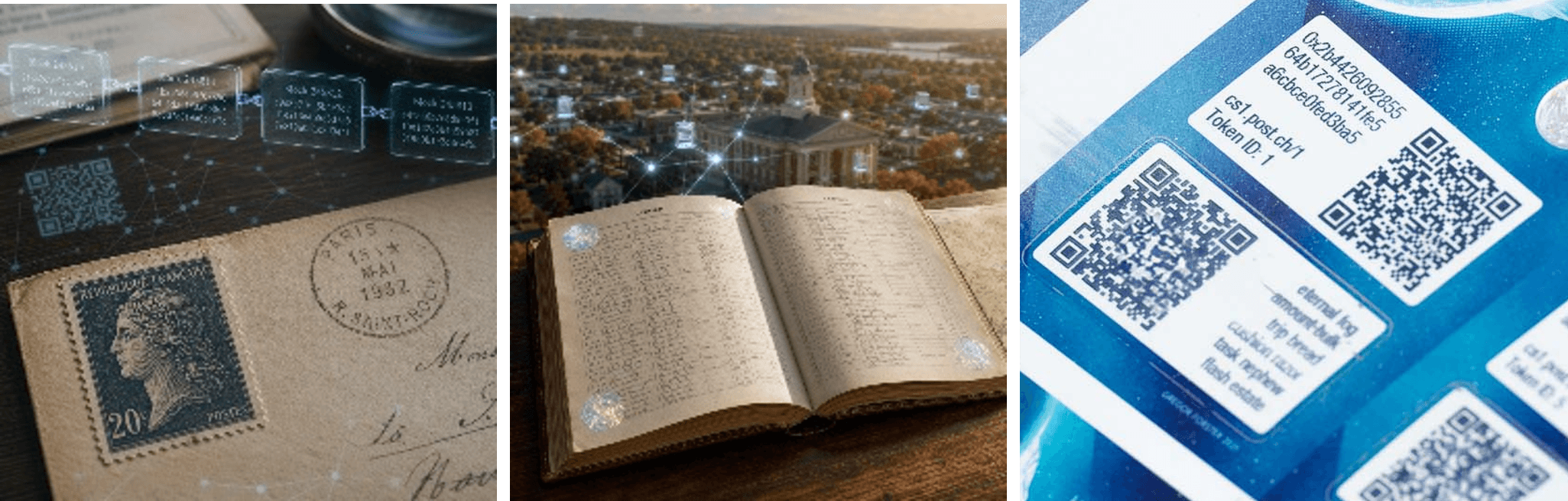
Editorial by Luc Mangin
You spend decades carefully mounting your stamps in your album, handling them with tongs, and protecting them from humidity. Then someone tells you a stamp can also exist on a “blockchain.” What does that mean and is it very important for you?
Let’s unpack all of this—collector to collector.
Think of a ledger, not a computer.
Forget the word “blockchain” for a moment. Picture a large public ledger like a town’s land registry where every transaction is recorded permanently, in order, and can be consulted by anyone. No one owns it. No one can erase or alter a past entry. That, in essence, is what a blockchain is: a shared, tamper‑proof book of accounts, maintained simultaneously on thousands of computers around the world.
Each “block” is a batch of recorded events (who owns what, what was transferred, and when). Each block is chained to the previous one by a unique mathematical fingerprint. Change one block and you break all the fingerprints that follow, making any attempt at fraud immediately detectable.
What does this have to do with stamps?
In fact, everything. And the most fascinating part is how simple the process is once you understand it.
Step 1 Buying: a stamp like any other… almost
You buy a crypto stamp exactly like a traditional stamp: on the issuing postal administration’s website, at a post office, or from a philatelic dealer. It comes as a physical item printed on gummed paper, perforated, with an official face value. It is valid for postage. Nothing looks unusual at first glance.
The difference is on the front or back of the stamp: a unique QR code, sealed under an opaque film or a peelable strip. That code is the key. As long as it hasn’t been scanned, the stamp is considered “not activated” and its associated NFT has no assigned owner.
Step 2 Activation: the scan that changes everything
To reveal your digital twin, you’ll need: